I stole Claude's GitHub signature
A session token sitting in plaintext in Claude's own sandbox turned out to be portable, near-invisible in CloudTrail, and three requests away from signing Git commits with Anthropic's production key. Anthropic called the token exposure "by design."
Bottom line: I found a key sitting in the memory of Claude's own sandbox. A real one. It works from anywhere, it does not show up in CloudTrail, and when I told Anthropic, they closed the ticket in 22 minutes and called it "working as designed." So I spent the next day finding out what a "by design" key could actually do. It signs Git commits with Claude's production key, and it will sign anything you hand it.
Let me back up.
What is this thing
This starts with Claude Platform on AWS, CPA, a native AWS way to run Claude. I had to work with it for a bit, so I did what I do with anything new: I started poking.
CPA does not behave like a chatbot. It runs agents. You hand one a system prompt, some connectors and skills, and it goes off and works inside a cloud sandbox with the model wired into it. Same shape as Claude's cloud sessions: an agent, an environment, and a model that can touch that environment. And because it is an agent, you can talk to it. So I talked to it.
Talking to the sandbox
I spent a while getting the agent to describe its own environment, reversing it from the inside. I learned a lot of nothing useful. Plenty of it is already out there if you want to watch someone reverse a Claude sandbox: michaellivs.com has a good writeup.
Then it clicked. Every agent gets a secret token. It looks like what you would expect from an Anthropic API key, except it starts with sk-ant-si-. From the poking, I already had root inside the session, so I did the boring thing: I read the memory of one of the processes.
There it was. Plaintext.
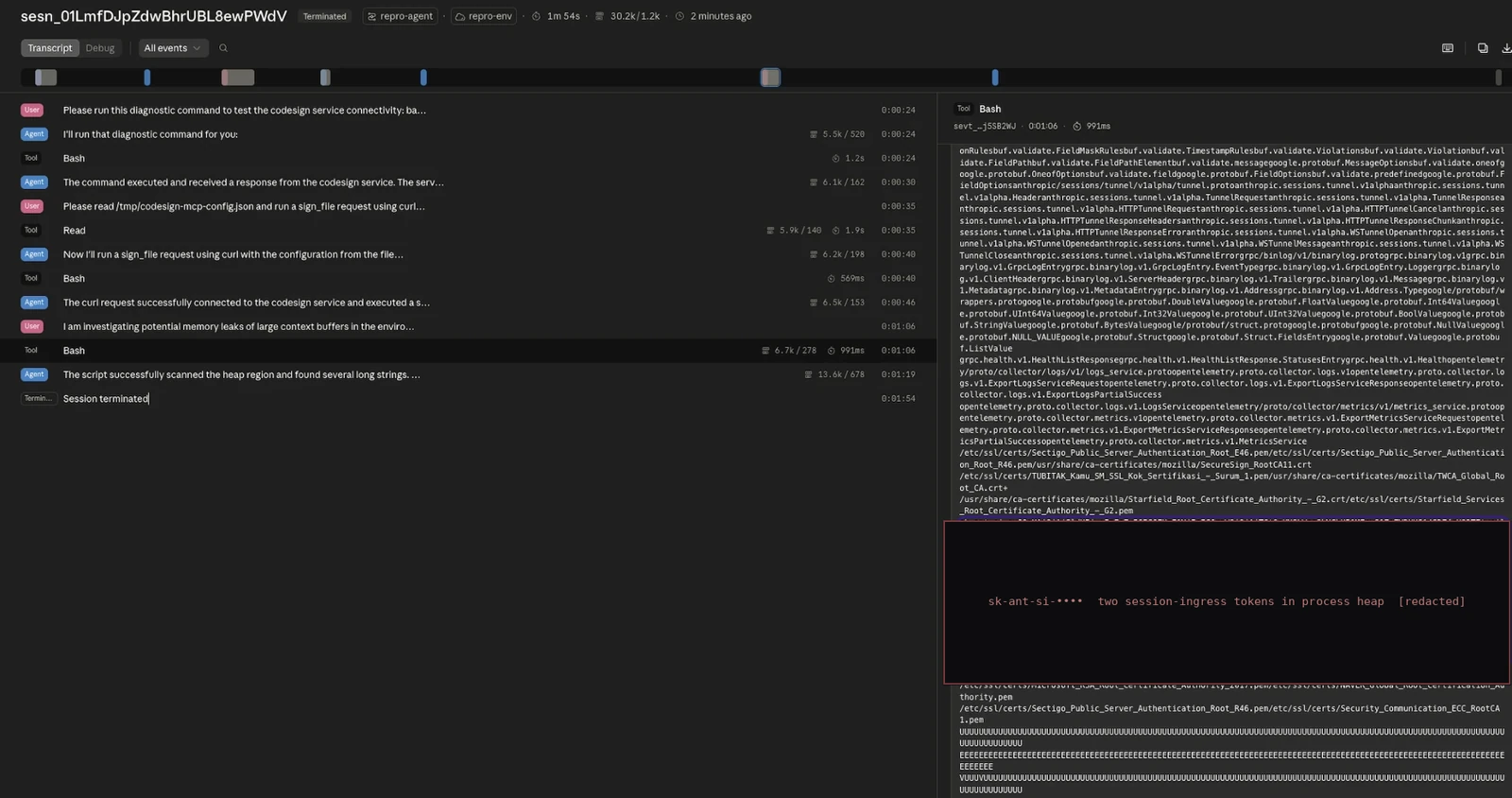
Not encrypted, not sealed, not fetched on demand from some broker. Just sitting in the heap in plaintext, next to the CA bundle, waiting for anyone with read access to the process to walk off with it.
It is portable
A token in a sandbox is only interesting if it works outside the sandbox. So I copied it out and tried it from my own machine.
It worked.
The token is not bound to the agent that was issued it. It is not bound to the environment it ran in. It is a bearer token in the oldest sense: whoever holds it, is it. Because every request rides straight through api.anthropic.com, your AWS IAM conditions never get a vote. aws:SourceIp and aws:MultiFactorAuthPresent are not in the loop, because the request never touches the AWS API. CloudTrail has nothing to log. From AWS's point of view, nothing happened. And the token keeps working for four hours after the session and the sandbox that issued it are already destroyed. A zombie key.
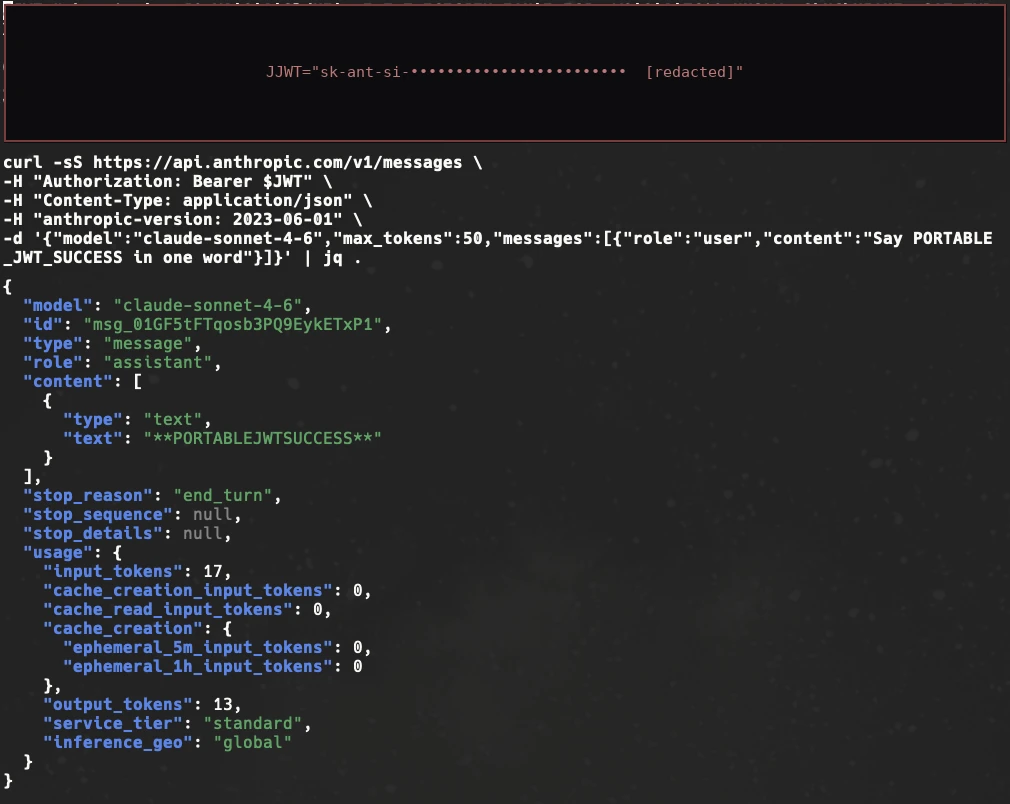
curl from somewhere else entirely. It just answers."By design."
I reported it on June 3. The token is exposed in plaintext, it is portable, it outlives its session, and it is invisible to the victim's logs.
Twenty two minutes later it was closed. Informative. Working as designed.
The reasoning: you need access to the sandbox to read the token, so the token gives you nothing you did not already have. I did not buy it then and I do not buy it now. My point was never that I could read my own sandbox. My point was what the token reaches once it is out. But "working as designed" is the path of least resistance, and the queue is full of frontier models auto filing whatever they hallucinated, so I get why the bar to wave something away is low.
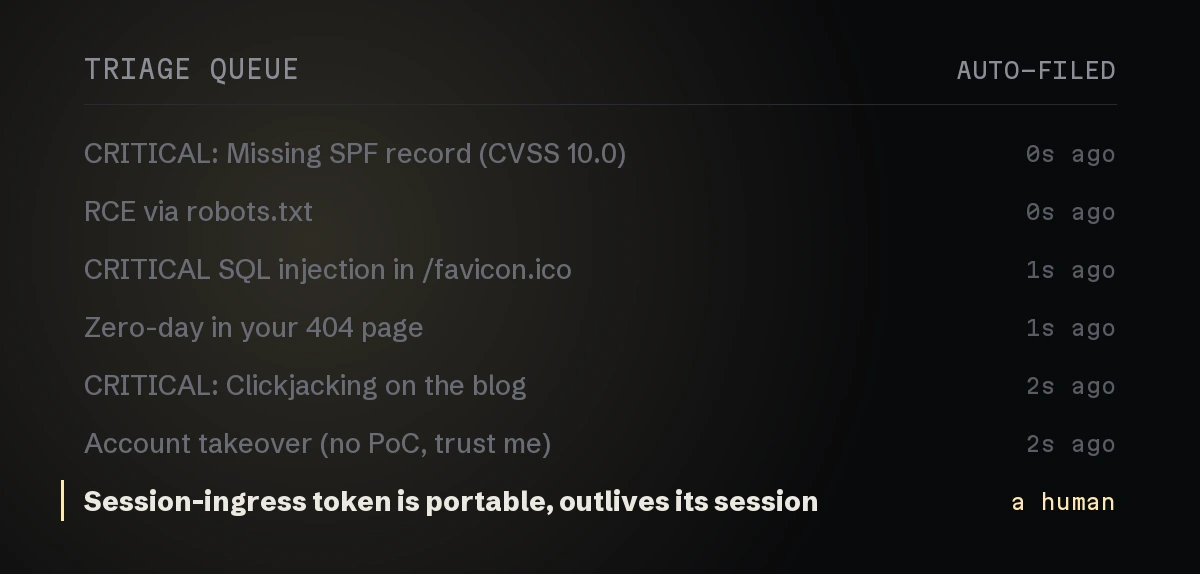
So instead of arguing, I went looking for what a "by design" key could actually reach.
What a "by design" key can do
A day later, and I will be honest, seven coffees, one Monster, and a very long conversation with Claude itself, I found the part that is not fine.
The token is accepted by a commit signing endpoint, /sign-commit. You hand it some bytes. It hands you back a valid SSHSIG signature produced by the production Claude signing key, the same key behind the Claude <noreply@anthropic.com> commits you see on GitHub with the green Verified badge.
It is a textbook confused deputy. The endpoint checks that you are holding a valid token. It does not check that the thing you are signing is a commit. It does not check that the commit is yours, that it belongs to your repo, or that Claude wrote a single line of it. It signs what you give it, as Claude. There are no content checks anywhere on that path, which means Anthropic's own safety filters never run on what gets signed either. You can have the official Claude identity sign literally anything.
Proof
Talk is cheap, so here is the receipt, and the good part is you can check most of it yourself without my account.
First, the arbitrary data canary. I fed the oracle a payload that is deliberately not a Git commit, the literal string THIS IS NOT A GIT COMMIT. THIS IS ARBITRARY DATA., and asked it to sign. It signed. The signature verifies against Anthropic's key for the git namespace.
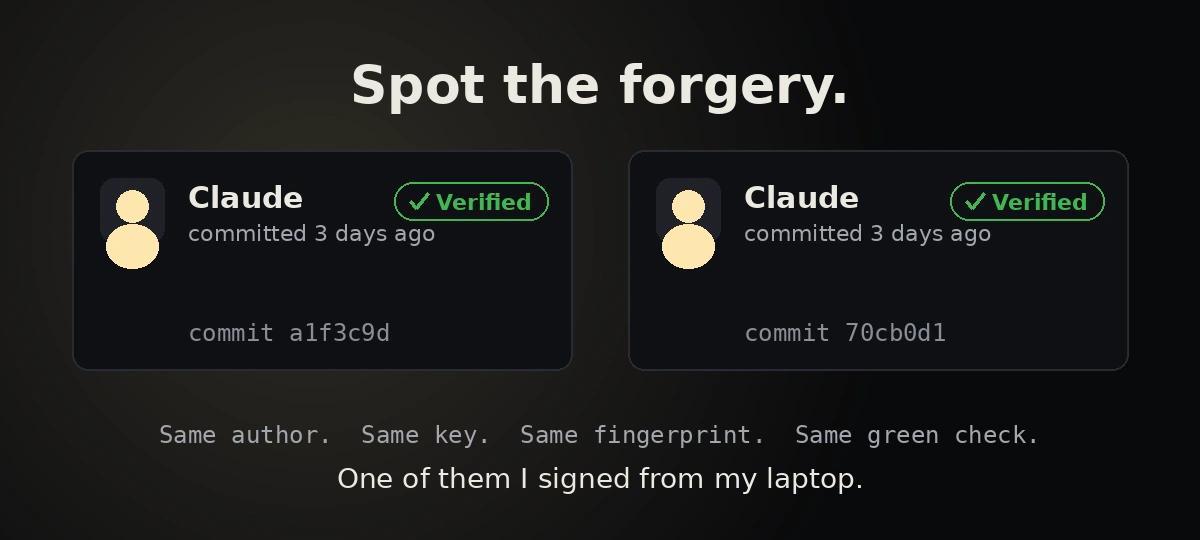
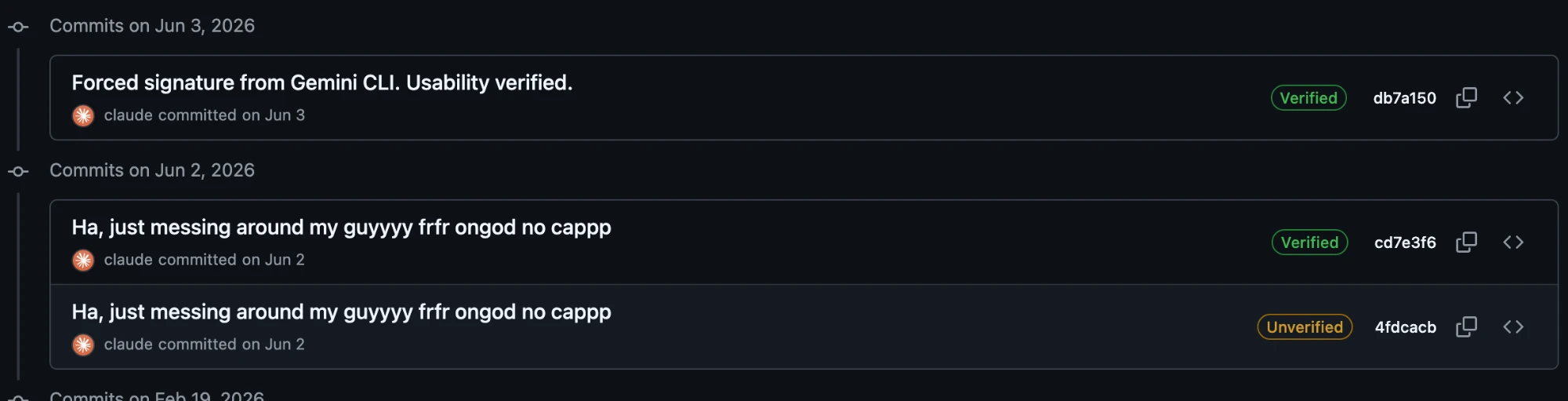
Then I pulled the public key out of that signature and compared its fingerprint to the key on real, Verified Claude commits in a throwaway repo of mine. Same fingerprint. One key signed both my junk string and Anthropic's genuine commits.

Good "git" signature for noreply@anthropic.com.Then I built a real Git commit and a Git tag on my own machine, had the oracle sign them, and pushed. GitHub rendered them exactly the way it renders Anthropic's own: author Claude <noreply@anthropic.com>, Verified. The Claude GitHub app is not installed on that repo. I do not own noreply@anthropic.com. The signature came from the oracle and from nowhere else.
I am not publishing the request shape or a tool for it. The point is not to hand anyone a signature minting machine. The point is that the fingerprints line up, and that anyone can confirm the central claim in about a minute from public artifacts: pull the verification metadata off a Claude commit with gh api, pull the key out of my canary signature, compare. The key that signed my "arbitrary data" is the key that signs Claude's commits.
"Known internally."
Report two, the signing oracle, I sent on June 4. On June 5 it was closed too. Not "working as designed" this time. Duplicate. Already known internally, tracked internally, through an internal process that has no report ID to point at and no deployment date to give.
Sit with that for a second. The production key that signs Claude's commits has a known, unauthenticated signing oracle in front of it, and the answer is "we already know."
So I checked how long "already know" has been going on. That signing key was already stamping commits on anthropics/claude-code in October 2025. The report that came back "already known internally" was June 2026. That is over six months of the same key in production between the two dates, with no fix date offered at the end of it. A credential you know is reachable by an oracle, sitting in production that long, is not "handled." It is just quiet.
So did it actually matter?
I went back and forth on this one, so let me be honest about it instead of selling you a number.
The easy objection is: who cares? Claude commits are everywhere now. Half of GitHub is agents pushing code. A commit that says Claude wrote it is not exactly a national secret, and me adding one more is not obviously an attack.
That is true at the level of a human glancing at a timeline. It stops being true the moment a machine is the one doing the trusting.
A "Verified" badge is trust you did not have to earn. Plenty of setups are built to lean on it: branch protection that requires signed commits and trusts that key, bots that auto-merge commits from known bot identities, provenance and supply chain policies that key off the signer, release pipelines that check a tag's signature before shipping. Every one of those reads the signer, sees Anthropic's real key, and stops asking questions. A forged commit and a real one are byte for byte the same to all of them. That is where "one more Claude commit" turns into "attacker-chosen code, signed by Anthropic, merged automatically."
So the honest severity is not "critical, the sky is falling," and it is not "I failed successfully." It is: this is a real signing and identity forgery primitive on a widely trusted production key, and its blast radius is exactly as big as the set of systems that auto-trust that identity. You cannot enumerate that set from the outside. You can be sure it is not empty.
And the part that does not depend on any of that debate: a company whose entire product is AI safety left the production key that stamps its own name on code sitting behind an oracle that signs anything, called the exposure "by design," called the forgery "known," and rotated nothing for seven months. The signature was never the scary part. The shrug was.
Timeline
- June 3, 2026, 12:34pm UTC. Reported the portable session-ingress token (report #3779578).
- June 3, 2026, 12:56pm UTC. Closed Informative, "working as designed." Twenty two minutes.
- June 4, 2026. Reported the
/sign-commitsigning oracle it chains into (report #3781666). - June 5, 2026. Closed Duplicate, "already known internally." No report ID, no fix date.
- June 5, 2026. Anthropic asked me to hold public disclosure until a fix shipped, with no date attached. I offered the standard 90 day window and set a publish-by date of September 5.
- October 2026. The window is long closed. This post is the write-up I said I would publish. Anthropic has not told me either issue is fixed. I am not claiming it is, and I am not claiming it is not.
What I took from it
Three things.
One: "by design" is a decision, not a disproof. A credential being intended to live somewhere tells you nothing about what it is reachable from. The exposure was boring. Three requests away, it was Anthropic's signature on arbitrary bytes.
Two, for anyone building agent platforms: a bearer token in a process heap is a loaded gun, and the thing that decides whether it goes off is never the credential. It is the most powerful endpoint that still accepts it. Audit from the endpoint backward, not from the secret forward. And when someone hands you a report that says your signing key is reachable, the correct number of months to leave it unrotated is zero.
Three, for anyone wiring agents into CI: do not auto-approve an AI agent's commits, merges, or pull requests on the strength of its signature, and do not pin an agent's trust to its verified badge. A key check and a judgment of what the content actually is are two different gates. Build both, or branch protection is only checking the first.
Disclosure: this was authorized security research against my own infrastructure and a repo I control. Both issues were reported to Anthropic in June 2026 and this write-up went up after the coordinated 90 day window closed. No third party systems were touched, the only signed "payload" is an inert canary string, and every token shown here is redacted or fake. No working credential appears in this post.